






Dilip Kumar
Founder and Marketing Director

Dhanasekar G
Co-Founder & CMO
TL;DR
- Up to 68.01% of Google Searches ended with zero clicks meaning
- AI extraction requires your page to have multiple cited sources and accessibility to AI bots. The average cited page by LLMs has an average of 19 or more specific metrics cited.
- Citations and brand mentions need to be prioritized through PR posts, community forums, and other platforms.
- To remain visible to AI crawlers, websites must bypass complex client-side rendering and inject 40-to 60-word standalone answer capsules
AI visibility for SaaS comes down to covering the best practices of its three components, namely AEO, GEO, and SEO. This is influenced by citations and brand mentions in community forums. Along with this, authoritative answers from verifiable sources are also prioritized.
But what is the issue here? Well, generative AI search has made traditional SEO a lot less effective.
This leaves everyone with the problem of dealing with how they can get AI visibility online.
So if you’re a SaaS founder or marketer, and this is something you’re facing, here’s how AI search optimization helps that.
What's Actually Changed with ChatGPT, Gemini, Claude, and Google AI Overviews
With AI software and overviews, what has changed is the criteria the algorithm ranks websites on.
This is done by, RAG or retrieval augmented generation, which does not rely only on keywords but rather context and expertise.
And more than this, Claude, Gemini, and ChatGPT prioritize experiential expertise in language, meaning:
- Google and AI look at whether this is an experience the writer has gone through and whether he has a solid understanding of how it plays out practically.
- But intent is higher - referrals from ChatGPT have 16% conversion rate as opposed to traditional 1 - 5% on traditional websites
- Google even mentioned in May 2026, AI Mode and AI Overviews prioritize actionable information from experts. Typically, those on community forums or social media are looking at quotes, links, or stats that validate this information.
SEO vs. AEO vs. GEO: What's the Difference?
SEO, AEO, and GEO are three components that make up AI visibility online. However, there are differences between the three in terms of how they work and the value they add.
- AEO : AEO, or answer engine optimization, where your website shows up in direct answers and AI overviews.
- GEO : In terms of GEO or generative engine optimization, you can define that as where LLMs like Chat GPT, Claude, and Gemini are inclined to retrieve your website as a citation source or even as an expert in a specific field.
- SEO : Traditional SEO is how well your website ranks on search engines like Google or Bing. This is driven by keywords and backlinks. along with the topics your website shows you’re an expert in.
The Main Differences Between SEO, GEO, and AEO
- Unlike traditional SEO, leads from generative search traffic are a lot more highly qualified. In fact, AI referrals convert to leads at 14.2% to 15.9%, which is a lot less when compared to standard organic search, which has 1.76% to 2.8%
- AEO is about helping users get answers and information rather than storytelling, looking for actual, actionable insights and information that help them immediately
- Generative search displays a massive freshness bias. This is seen when compared to traditional SEO. What this means is that it gives pages updated within the last 90 days a 3.2x multiplier in citation frequency.
- A lot more than SEO, to get Generative Engine Optimization or GEO citations, you need to have brand representation. This is ideally in pages that are not your own. And to do this, have an entity-rich GEO strategy.
Why Do SaaS Blogs Struggle with GEO and AEO?
The main reason SaaS blogs struggle with GEO and AEO is that core algorithms and spam updates systematically prioritize legacy brands.
This means brands that have had an impact over the last decade or more years, rather than newer blogs or SaaS companies, are prioritized.
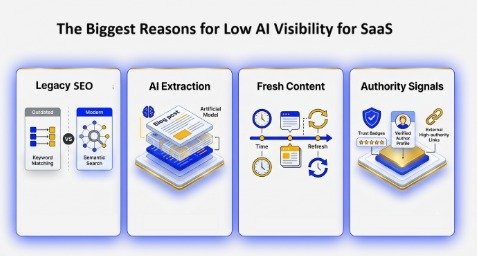
These updates are systematically pushing AI visibility for SaaS to lower search results. But aside from some of these, some of the main reasons SaaS companies struggle with AI visibility are:
-
- Unrelated Headings Based on Outdated SEO: Many companies bury answers behind keyword-heavy content instead of addressing user intent. AI platforms prefer content that provides clear, direct, and easy-to-read answers.
- Blocking AI Bots: Many CDNs and website configurations unintentionally block AI crawlers from accessing content. Review your robots.txt file and crawler settings to ensure AI bots can index your pages.
- Content Isn't Optimized for AI Extraction: AI systems prioritize factual, structured content over lengthy introductions and unnecessary filler. Use concise answer blocks, clear headings, and well-organized sections that improve AI extractability.
- Outdated Content: Large Language Models tend to reference recently updated content. Blogs refreshed within the last 13 weeks with new statistics, citations, and expert insights have a higher likelihood of being referenced by AI search engines.
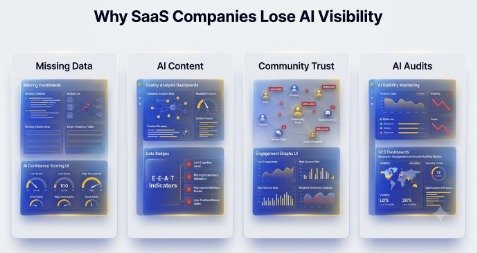
- Not Enough Data: Afraid of losing link equity, SaaS companies do not add external links and stats. An AI-retrieved page has an average of 19 verifiable stats or research metrics.
- Generative Slop: CEOs and Managers think output is everything. But the reality is that modern algorithmic filters look at experienced expertise and honest answers. Shameless promotion in SaaS content and generic AI-generated content prevents this.
- No Community Forum Footprints: Generative AI looks at community forums like Reddit and Quora, which they scrape heavily for real-world non-promotional content. Most SaaS companies do not have any visibility there.
- Credentialed Author Verification: Most authors of SaaS blogs do not have any credentials, such as external industry credentials or Wikidata profiles.
- No Authoritative Content Pages: For SaaS technical pages with API feature documentation, are they the type of data LLMs want? Unfortunately, most SaaS companies protect this information or do not create it.
- Ignoring AI Visibility in Audits: Most SEO site audits fail to look at AI crawler logs, prompt visibility tracking, or even run citation gap analysis.
The E-E-A-T Foundation AI Models Actually Check
For AI models to prioritize your site E-E-A-T (Experience, Expertise, Authoritativeness, and Trustworthiness) is essential. Achieving AI visibility for SaaS companies requires the following criteria to be considered:
- Cited Sources: Adding verified external research, statistics, and direct expert quotations boosts AI search visibility by a massive 115.1%
- Domain-Level Topical Authority: AI selection algorithms favor concentrated expertise at the domain level. In fact, 82.5% of AI search citations originate from websites that demonstrate deep topical coverage (not only BoFu keywords).
- Citation Metrics in Reddit: ChatGPT, Gemini, and Claude evaluate user-created content and cite Reddit as the source of information and product recommendations more than 5.53% of the time.
- Citation Neutrality Requirement: AI systems have an inclination toward neutral and unbiased information and generally avoid or filter out any webpage that is persuasive or biased.
- Client Proof:The inclusion of proof of a client and comparative data in credible third-party websites like Gartner or G2 increases a company’s AI citation rate.
- Expert Author Citation Multiplier: Web pages that feature clearly identified expert authors are 3.2x more likely to be cited
- Machine-Readable Credential Parsing: AI engines algorithmically parse Person schema fields. This can refer specifically to them checking the jobTitle, knowsAbout, and sameAs properties in the schema.
- Person and Author Schema Validation: Adding an explicit Person /Author schema connects the content creator directly to verified credentials, professional affiliations, and external profiles
How Do I Structure Content for AI Extraction and Visibility?
Structuring content for AI extraction requires content-level guidelines, technical SEO guidelines, as well as PR and community building. In 2026, AI visibility for SaaS needs to be tackled on multiple levels, the main ones we've listed below.
- Add a TL;DR Block: Adding a crisp, bulleted 3-to-4 sentence summary section at the top of long-form articles helps with AI extraction.
- Add Core Insights at the Top: Position your primary statistics, brand mentions, and central conclusions within the first 30% of the web page.
- Use 90-Day Freshness Cycle: Set a recurring quarterly schedule to prune and update static pages to satisfy the temporal biases of generative.
- Draft Answer Capsules: Place a 1-to-2 sentence direct answer (40 to 60 words) immediately beneath section headings to maximize the likelihood of a direct citation.
- Rewrite Headings into Questions: Rewrite subheadings as complete, conversational questions that actually happen in real-world conversational search and LLM conversations.
- Domain-Level Topical Depth: Make sure your content is heavily about a tight, specialized niche to build high topical authority vector signals.
- Add Person and Author Schema: Link your author profiles to verified professional credentials, external portfolios, and LinkedIn profiles.
- Modify CDN Firewall Settings: Set up bot management systems such as Cloudflare to ignore any security barriers put in place for AI search engines.
- Improve Brand Mentions: Start digital PR campaigns that generate brand mentions in high authority sources.
- Use Community Forums: Initiate and start active product discussions, user answers, and natural recommendations on community spaces.
What Is a Practical AEO/GEO Content Framework for AI Visibility?
Practically speaking AEO and GEO both have similar frameworks. In terms of AI visibility for SaaS companies it depends on offsite trust and how well AI bots can access your information and answers.
- Topical Clustering: Avoid creating isolated, single-keyword blog posts. To do this, add all text assets into highly concentrated topical clusters.
- Structural Semantic Chunking: Make sure there are strict formatting rules that limit body paragraphs to a maximum of three or four sentences per block.
- No Uncertain Language: Remove uncertain, non-committal terms (such as "may," "might," or "potentially") from introductory text and content.
- No JavaScript-based Tables: For feature tables and pricing metrics, use plain HTML tables. This helps RAG scrapers process information much more easily.
- Build Off-Site Trust: Assign a portion of link-building budgets to external digital PR to create frequent, unlinked textual brand mentions.
- Change Your Strategy to Leads: Structure your reporting framework around Qualified Lead and Sales Pipeline Attribution metrics. Traffic and volume play a much smaller role with AEO and GEO.
- Glossary Pages: Publish glossary pages on sector-specific terminology to establish authority as a canonical entity resource.
- Monthly or Weekly Prompt Gap Audits:Look at a fixed list of 50-100 buying prompts within Perplexity, Gemini, Claude, and ChatGPT. By doing this, weekly or monthly, you and your company can consistently track Citation Share of Voice.
How Should SaaS Companies Measure Success with AEO and GEO?
Unlike traditional SEO, where success is measured by keywords ranked and site traffic, AEO and GEO are measured by AI citations and prompt mentions. Aside from that, for SaaS AI visibility, we've listed some of the other criteria below.
- AI Citations and Prompt Mentions: Platforms like Semrush allow users to track metrics such as AI citations and prompt mentions. SaaS companies can also manually monitor their AI visibility and citation performance.
- LLM Crawler Log Monitoring: Analyze server access logs to track the crawl frequency of AI bots such as GPTBot and PerplexityBot.
- Comparative Share of Voice Gaps: Chart your brand's citation frequency directly against your top three market competitors.
- Topical Authority Vector Scores: Utilize third-party GEO tools to assess your site's semantic vector alignment with high-value transactional search. These would be tools like the Semrush AI Visibility Toolkit, Ahrefs Brand Radar, OptimizeGEO, or even iGEO.
- SQL and Demo Request Quality: Look at the downstream closing rate of AI-referred leads, measuring if AI Buyers close faster than standard organic SEO leads.
Bottom Line
In 2026, achieving AI visibility for SaaS companies is a matter of quality and structure. But more importantly, also verifying to Google, ChatGPT, and Claude that your information and authors can be trusted.
This needs to be done with building your brand presence using PR, Reddit, and Quora- but also technical SEO aspects like making sure there is detailed schema on all pages, and Bots can extract data.
But doing this requires an effective GEO and AEO strategy in place.
SaaS Inbound has been able to do this for SaaS companies like Jumio, where the results spoke for themselves:
- Organic traffic increased from 25,000 to 45,000 monthly visitors within 15 months.
- Monthly signups growing consistently to an average of 580 qualified signups per month.
- The campaigns generated 9,109 signups while managing a total advertising investment of $922,734, maintaining an average cost per conversion of approximately $101.
Have any questions or need a B2B marketing audit?
Reach out to know how SaaS inbound can guide you through that journey….
Reach Out