







Dilip Kumar
Founder and Marketing Director

Dhanasekar G
Co-Founder & CMO
TL;DR - Summary:
- Ranking in AI overviews is a lot more likely if you rank in the top 10 positions of SERP. But also, depends on how much your brand is mentioned related to this topic off site.
- AI overviews does not drive conversions but should be looked at as a brand awareness channel
- Query based questions trigger AI overviews a lot higher. This means building things like glossary pages are helpful to help you rank in them.
- AI-generated answers link to at least one top-10 domain in over 92% of cases. Meaning ranking higher definitely improves chances.
Ranking in Google’s AI Overviews comes down to four things: your page already ranks in the traditional top 10, it answers one question precisely, your domain shows depth across a whole topic instead of one lucky post, and your brand gets talked about off-site too.
That’s it - no plugin, no secret prompt, no growth hack.
This playbook is written for SaaS marketers specifically, not generalist SEO agencies.
Here’s the useful part: research across 146 million SERPs found that roughly 76% of AI Overview citations also hold a traditional top-10 spot, with a median position of 2.
So essentially, SaaS companies need to win the fundamentals first - everything below is about layering AIO visibility on top of that.
What Counts as “Ranking” in an AI Overview
Let’s clear up a common misconception first: there’s no position #1 inside an AI Overview, the way there is in classic search results.
Google either cites your page by linking your URL directly inside the AI-generated box, or it mentions your brand by name without linking anywhere.
- Citations link directly to your URL and drive traffic. Mentions name your brand without a link and build brand association, even when nobody clicks.
- AI Overviews aren’t static. Refreshing the same query can surface a different set of sources, especially ones tucked behind “Show more” or “Show all,” so don’t build your reporting around chasing one fixed rank.
- According to SearchEngineLand, AI Overviews include citations from three or more sources around 88 percent of the time, although just 1 percent of users click any citation link, and people only read the first few lines of content before switching.
- AI Overviews exist within normal search results, but AI Mode is a distinct conversational interface optimized for multi-session research purposes, such as evaluating five products before scheduling a demo.
Why This Matters More for SaaS Than You Think
Here’s the section most AIO guides skip, because it’s specific to how SaaS buyers actually behave.
B2B buyers increasingly start their research inside AI answer engines instead of typing a brand name straight into Google.
By the time someone lands on your pricing page, they’ve often already read a summary of your category, your competitors, and KNOW what good looks like. But here’s what to keep in mind with this:
- AIO visibility should NOT be looked at as a last-click conversion channel. It’s an awareness and consideration play, closer to category education than lead gen, so set that expectation with stakeholders early.
- A Reddit thread in r/marketing summed it up well: AI Overviews provide visibility, not traffic, and treating the two as the same thing makes a working strategy look like underperformance.
- Your docs, integration pages, comparison pages, and glossary already look like the structured, definitional content AI systems are built to extract. You don’t need new content types, you need to stop wasting the ones you already have.
Step 1 — Target the Right Query Types
Not every keyword triggers an AI Overview, and chasing the wrong ones wastes your team’s limited hours.
Question-based, “why,” yes/no, and definition queries trigger AI Overviews far more reliably than short transactional searches.
- “Buy CRM software” is far less likely to surface a summary than “why is my CRM data not syncing,” since Google saves that top slot for product listings and ads instead.
- Ignore any suggestions related to using a keyword tool. The best place for you to get authentic questions is from your existing customer support tickets, call transcripts, and discussion forum conversations.
- Use the actual language that your customers use to ask questions when they have issues. This is a lot more likely to be realistic than anything you can pull from a keyword tool.
Query Types and Trigger Rates
| Query Type | AIO Trigger Rate | SaaS Example Query |
|---|---|---|
| Question-based | 57.9% | “why is my CRM data not syncing” |
| Definition / “what is” | High | “what is a workflow automation tool” |
| Comparison / “vs” | Moderate-High | “what is the difference between X and Y software” |
| Yes/No | Moderate | “is [category] software worth it” |
| “Best of” / roundup | High (commercial) | “best project management software for remote teams” |
Step 2 — Win Traditional Top-10 Rankings First
There’s no AIO shortcut that skips traditional rankings, because AI Overviews pull from Google’s existing search index rather than crawling the live web on the fly. If your page isn’t indexed and ranking well already, it isn’t eligible for a citation, full stop.
- Anastasia Kotsubynska, an organic strategist at SE Ranking, found that AI-generated answers link to at least one top-10 domain in over 92% of cases, and pull information directly from top-10 pages roughly 63% of the time.
- A popular r/SEO thread reached the same conclusion from a different angle. Normal SEO fundamentals still work for AI Overviews, and there’s no separate playbook that bypasses them.
- Don’t let leadership treat AIO as a separate initiative from core SEO. It’s a layer on top of it.
Step 3 — Match Intent Precisely (Don’t Pad Word Count)
Forget the old rule that competitive SaaS terms need 3,000-word guides to rank.
Research across 146 million SERPs found almost no relationship between total word count and citation rate, with the correlation sitting close to zero. What actually predicts a citation is whether a single passage fully answers the question on its own.
- The SaaS-specific trap is bolting a “why choose [Product]” pitch onto an otherwise useful educational section.
- That mix of information and sales copy dilutes a passage’s extractability, since the model can’t isolate a clean answer when it’s sandwiched between a feature list and a CTA button.
- The solution is to keep them apart. The educational portion should be a completely separate block, and the hyperlink will go to the commercial part.
Step 4 — Build Topical Authority via Fan-Out Queries
Google’s AI Overviews don’t just check the page matching your exact search. They run a batch of related background searches first, a process called query fan-out, to verify the answer from multiple angles.
Pages that rank across an entire cluster of related searches are dramatically more likely to earn the final citation.
- One analysis found a 161% higher citation likelihood for domains covering the full fan-out set instead of just the head term, backed by a strong statistical correlation.
- You don’t need an enterprise tool to map this. Free options like AlsoAsked or Qforia surface the follow-up questions people ask after an initial search.
- AnswerThePublic is good for mapping raw phrasing around a core topic.
One Fan-Out Example for the Term “Workflow Automation”
For instance, for the Seed topic: workflow automation you should cover:
- Use cases by team (marketing, ops, HR)
- Integrations with existing tools
- ROI and time-savings benchmarks
- Alternatives and how they compare
Create one pillar page using the seed keyword, followed by a separate supporting page for each of the branches.
Connect all these pages with relevant anchor text, which will help the Google spider see the pages as a one complete cluster rather than four independent pieces.
Step 5 — Convert Your Existing SaaS Assets Into AIO Bait
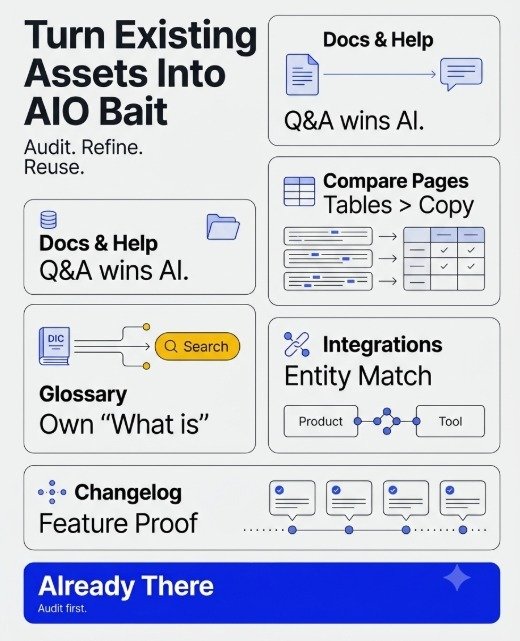
Most SaaS companies are sitting on a stack of content that’s already halfway optimized for AI Overviews and AI visibility. The main issue is that it just hasn’t been audited with that lens.
- Docs and help center articles: These are often already written Q&A-style, which is exactly the format AI systems look for. A quick pass to tighten the direct answer at the top of each article goes a long way.
- Comparison and alternatives pages: Reformat them as clean, structured answers instead of pure sales copy. A table beats three paragraphs of prose every time.
- Integration pages: They answer a specific and entity-based question such as "does[Product] integrate with [Tool]”, almost verbatim. Is one reliable strategy for SaaS AI visibility.
- Changelogs and release notes: Do not underestimate their importance. Well-written changelog can answer a “does [Product] support X” question directly.
Step 6 — Earn Brand Mentions Beyond Your Own Site
Google’s generative systems weigh something researchers call the “consensus layer,” how often your brand gets talked about across the web, linked or not.
One analysis found branded mentions correlate with AI Overview appearances at 0.664, compared to just 0.218 for traditional backlinks. Being talked about matters more than being linked to.
- Get into “best [category] software” roundups. These commercial, comparison-style queries trigger AI Overviews at a high rate, and third-party roundups are a common source Google pulls from, though you can’t buy your way in.
- Collaborate with YouTubers producing demo or review content in your product area. YouTube represents 23.3% of AI Overview citations by itself, more than any other single site.
- Your brand needs to ne found where communities gather, this includes places like Reddit discussions, G2 or Capterra reviews, and Slack or Discord forums.
- Discussions inside r/SEO have noted that these generative systems increasingly pull grounding evidence from this kind of community content, not just polished brand pages.
- Check where competitors get mentioned on high-authority pages you’re absent from, and pitch yourself for the next update.
Step 7 — Use Structured Data (Low Risk, Uncertain but Real Upside)
Google’s own documentation says schema markup isn’t required to appear in AI Overviews. Any page eligible for a normal search snippet is technically eligible for a citation, schema or not. That said, independent research has found a strong correlation between structured data and citation success.
- One estimate put schema-supported pages at a 73% higher selection rate, since structured data reduces ambiguity for the crawler even without guaranteeing anything.
- In order to optimize your SaaS content, you should use the SoftwareApplication schema on your products’ pages, FAQPage schema on the help center and question-and-answer sections, HowTo schema in your setup guides, and Article schema for the blog.
- If the content on your marketing pages is rendered via JavaScript frameworks, then the crawler will see only the page skeleton without any content on it.
How to Measure AI Overview Visibility
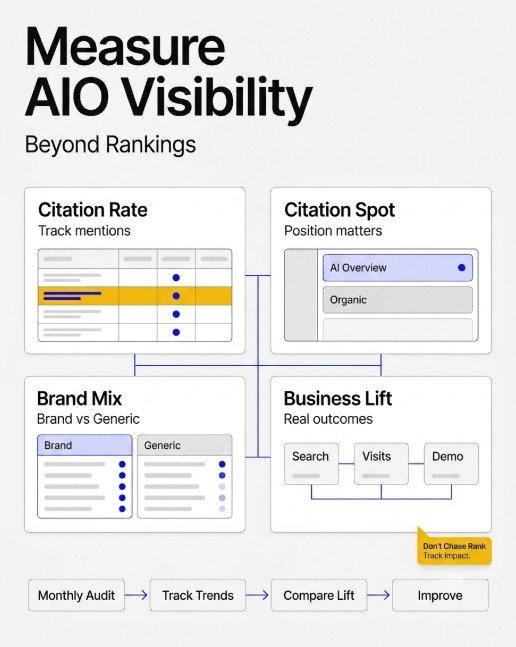
This is the part most competitor guides skip entirely, probably because it’s less satisfying than a tactics list.
Track three things: how often you’re cited for a given topic, where that citation sits, and whether citations skew toward branded or non-branded queries.
- Standard rank trackers won’t show you this. A page can hold position #1 organically while an AI Overview absorbs the click above it, and your dashboard will look completely unchanged.
- Do not go after this metric alone. Combine citation tracking with search lift, direct visits, and demo requests attributed over time.
- Think of AIO visibility as a lead generation indicator that will ultimately feed into the funnel, but cannot be attributed to a won deal.
- A monthly citation audit should do the job for most teams. The daily one is useless because it will be changing all the time.
A Prioritization Framework for Lean SaaS Teams
If you’ve read this far, you’ve probably realized a full AIO overhaul could eat a quarter of your team’s time. Here’s the order that gets you the most visibility for the least effort.
Suggested Order of Operations
- Fix top-10 rankings for your existing informational content first.
- Trim the sales pitch out of your best-performing educational pages before writing anything new.
- Turn your docs and comparison pages into AIO-eligible assets.
- Run one fan-out exercise on your single highest-value topic cluster.
- Pursue two or three high-authority “best of” placements.
- Set up a monthly citation-tracking check-in and actually stick to it.
Work through it in that order. Steps 1 through 3 use assets you already have, and that’s where the fastest wins live.
FAQs on Ranking in AI Overviews
The Bottom Line
AI Overview visibility moves with every algorithm update, every competitor’s content refresh, and every new dataset Google trains on.
At SaaS inbound, we position our AI visibility strategy to keep your page getting AI cited and stay visible through the core updates with strong fundamentals.
Based on your SaaS company, we curate ABM, performance marketing, and AI visibility campaigns that keep SaaS visibility increasing consistently.
For AI overviews, we help you handle it just as you would any other SEO, which is a process and not a project with a deadline.
- Using the practices listed above in your current content strategy instead of doing it on a tangent.
- Using citations and brand mentions,to ultimately drive your ICP to your sales funnel.
To do this, SaaS Inbound has worked with companies to improve AI citations.
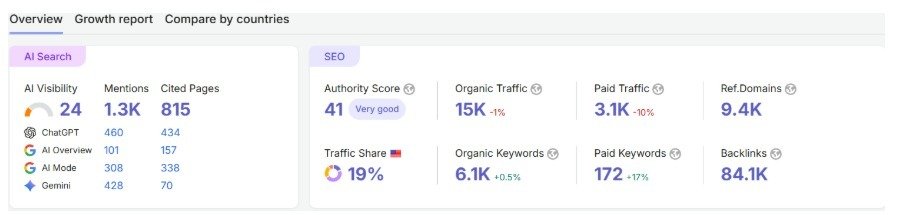
In fact, for an enterprise cybersecurity company, we improved KPIs, such as increasing monthly traffic 15,000 clicks with AI-mentioned pages to over 1300 and 815 AI cited pages.
Want to know what that could look like for you? Book a free consultation call!